Normalization in Machine Learning
Machine learning usually makes use of the data preparation process known as normalization. Normalization is the process of scaling all the dataset columns to the same value. Machine learning does not require the normalization of every dataset. Even though normalization is not a requirement for all datasets available for machine learning, it is applied if a dataset’s attributes have a range of values that differ from one another. It aids in improving the performance and dependability of a machine learning model. We will briefly examine various normalization approaches in machine learning, their uses, examples of normalization in ML models, and much more in this article. In order to get started, let’s define normalization in machine learning.
What is Normalization in Machine Learning?
Before analyzing the data using machine learning algorithms, pre-processing the data is crucial to achieving acceptable classification results. It involves noise and outlier removal, data integration from multiple sources, handling of incomplete data, and data transformation to equivalent dynamic ranges.
Data normalization is a crucial pre-processing step for transforming features into a similar range to remove the dominance of larger numeric values over smaller ones. Data normalisation, one of these, is a crucial pre-processing step that entails transforming features into a similar range so that larger numeric values of features do not supplant features with smaller numeric values.
The accuracy of the data required to create a generalised predictive model for various problems is crucial for the effectiveness of machine learning algorithms. Data normalization is a type of pre-processing technique in which the data is scaled or changed to ensure that each feature contributes equally. This technique is employed while preparing data for machine learning. The purpose of normalization is to convert the values of the dataset’s numeric columns to a standard scale without affecting the distinctions between different value ranges or omitting crucial details. Normalization is also necessary for some of the algorithms to accurately model the data.
Let’s take a simple example to see how data gets “normalized”.
from sklearn import preprocessing
import numpy as np
nixus_array = np.array([16,12,20,22,6,8,23,4,7])
norm_array = preprocessing.normalize([nixus_array])
print(norm_array)
Output:

Types of Normalization techniques in ML
The types of normalization that are most frequently employed in machine learning include:
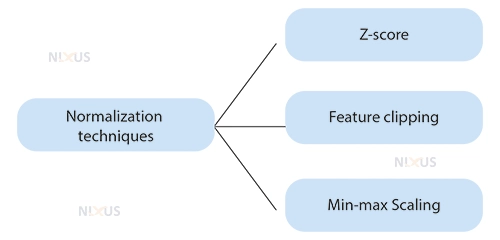
1. Min-Max Scaling: Divide the result by the range after deducting the minimum value from the highest value in each column. The minimum and maximum values for each new column are 0 and 1, respectively.
2. Standardization Scaling: The process where centering a variable at zero and standardizing or setting the variance at one is done is referred to as “standardization.” The process is: divide by the standard deviation after subtracting the mean of each observation. This type of normalisation is also known as “Z-score” normalisation.
This method is beneficial for various distance-based machine learning methods, including K-means clustering, KNN, and Principal component analysis, among others. It’s also crucial that the model is founded on assumptions and that the information is generally distributed.
3. Feature Clipping: Suppose, if some dataset consists of extreme outliers then the best idea is to consider feature clipping, which sets a fixed value for all feature values below (or above) a predetermined value. You could, for instance, clip the pixel values above 120 to be exactly 120.
Importance of Normalization in Machine Learning
When normalisation is performed correctly, more valuable insights are generated. Specific feature values in machine learning occasionally diverge from others repeatedly. The features with greater values will always dominate the learning process. These variables are not necessarily more critical for predicting the model’s outcome, though. Data normalization equalizes the scale of the multiscaled data. After normalization, all variables have about equal weights in the model, which enhances the learning algorithm’s performance and stability. Each variable receives equal weight during normalization, ensuring that no one variable dominates the model’s output. Additionally, it prevents any problems caused by database modifications (e.g., insertions, updates, and deletions).
Businesses must routinely execute data normalization if they are to grow. Eliminating errors that make data analysis challenging and complex is one of the most crucial tasks that can be performed by it. An organisation can utilise its data more effectively by using normalisation and invest more efficiently in data collection.
When to use normalization in machine learning
Normalisation is a wise strategy to use when you don’t know your data’s distribution or when you recognise it isn’t Gaussian. Normalization is proper when the data has different scales and the technique, for example, K-nearest neighbor (KNN) and Artificial Neural Network (ANN), does not make assumptions about data distribution.
As we know, for machine learning, every set of data does not need to be normalised. It is only required when the characteristics ranges differ. Consider a data set that involves two variables: age and income. Where the age range is 0 to 80 years old, and the income range is 0 to 8,00,000 rupees and higher. Income is approximately 10,000 times greater than age. Hence, the ranges of both these characteristics are drastically different.
When we conduct analysis, for example, multivariate linear regression, the attributed income will naturally have a greater impact on the outcome due to its higher value. It doesn’t necessarily mean that it is a more accurate predictor, either. Therefore, data normalisation is performed to ensure that all variables fall within the same range.
To overcome the challenge of model learning, we normalise the training data. To ensure that gradient descent converges more quickly, we ensure that the different features have comparable value ranges (feature scaling).
Conclusion
By generating new values and retaining the ratio and general distribution of the data, normalisation prevents issues with raw data and other problems in datasets. Additionally, it employs various approaches and algorithms to enhance the performance and accuracy of machine-learning models. Thus, the idea of normalization is crucial to creating a stronger ML model.